
SMILE Eye Surgery in Turkey: Benefits, Cost and Recovery
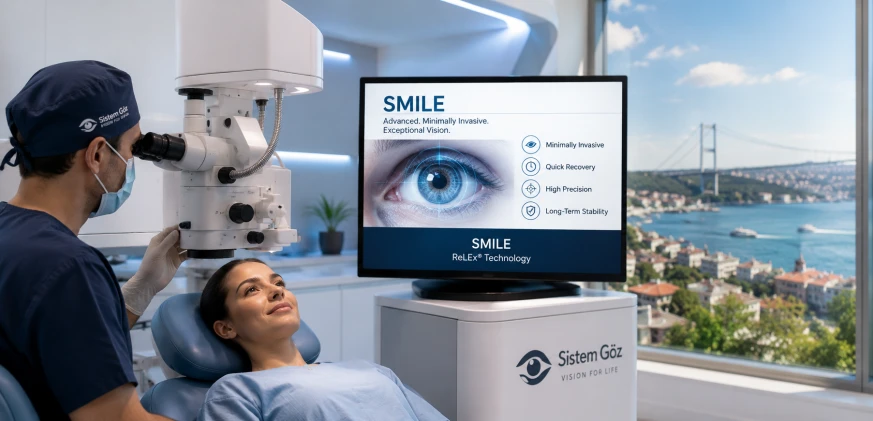
SMILE Eye Surgery in Turkey: Benefits, Cost and Recovery
SMILE eye surgery is a minimally invasive laser vision correction procedure mainly used to treat myopia and certain types of astigmatism. Unlike LASIK, it does not require the creation of a large corneal flap.
For international patients researching laser eye surgery in Turkey, SMILE is often considered because of its small incision, relatively fast recovery and potential advantages for patients concerned about dry-eye symptoms or flap-related issues.
However, SMILE is not suitable for every patient. A detailed eye examination is required before the procedure can be recommended.
What Is SMILE Eye Surgery?
SMILE stands for Small Incision Lenticule Extraction.
During the procedure, a femtosecond laser creates a small disc-shaped piece of tissue, called a lenticule, inside the cornea. The surgeon then removes this tissue through a small incision. Removing the lenticule changes the corneal shape and helps light focus more accurately on the retina.
The American Academy of Ophthalmology describes SMILE as a laser refractive procedure primarily used for nearsightedness and astigmatism.
How Is SMILE Different From LASIK?
The main difference is the way the cornea is treated.
LASIK requires the creation of a corneal flap. The flap is lifted, the underlying cornea is reshaped with an excimer laser and the flap is repositioned.
SMILE does not create a large flap. Instead, the surgeon removes a lenticule through a small incision.
This means SMILE may offer:
- No LASIK-style corneal flap
- A smaller incision
- Less disruption of some corneal nerves
- Potentially lower early dry-eye impact in selected patients
- Reduced concern about flap displacement after trauma
- A relatively quick return to many daily activities
Recent reviews suggest that SMILE and femtosecond LASIK can both provide effective refractive correction, while SMILE may offer advantages in tear-film stability and early dry-eye outcomes.
Who May Be Suitable for SMILE?
SMILE may be considered for adults with:
- Stable myopia
- Suitable levels of astigmatism
- Stable glasses or contact-lens prescription
- Adequate corneal thickness
- Healthy corneal shape
- Realistic expectations
- No active eye infection or uncontrolled eye disease
The final decision depends on the specific laser platform, regulatory treatment range and individual eye measurements.
A patient should not be approved for SMILE based only on age and prescription. Corneal topography, tomography, thickness and overall eye health must also be evaluated.
Who May Not Be Suitable?
SMILE may not be appropriate for patients with:
- Keratoconus or suspected corneal weakness
- Significant corneal irregularity
- Unstable prescription
- Severe untreated dry eye
- Active eye inflammation
- Certain autoimmune conditions
- Pregnancy or breastfeeding, depending on medical advice
- Refractive errors outside the approved treatment range
- Unrealistic expectations
Some patients who are not suitable for SMILE may be better candidates for PRK, LASIK, ICL surgery or non-surgical correction.
What Are the Main Benefits of SMILE?
Small incision
SMILE uses a much smaller corneal opening than a traditional LASIK flap.
Flap-free procedure
Because there is no large flap, there are no LASIK-style flap displacement complications.
Relatively fast recovery
Many patients can return to light daily activities within a short period, although visual sharpness may continue to improve over several days or weeks.
Potential dry-eye advantage
Because fewer anterior corneal nerve fibres may be affected, SMILE may have less impact on the ocular surface in selected patients. A 2025 meta-analysis found better tear-film stability after lenticule extraction than after femtosecond LASIK at several postoperative time points.
Suitable for active lifestyles
The absence of a large corneal flap can be relevant for people involved in contact sports, military work or occupations with a risk of eye trauma.
What Are the Possible Limitations?
SMILE is not automatically superior to LASIK or PRK.
Possible limitations include:
- It is mainly used for myopia and astigmatism
- Hyperopia treatment may be more limited depending on the system
- Visual sharpness can develop more gradually than after LASIK
- Enhancement treatment may require a different surgical approach
- Some customised treatment options available with LASIK may not be available with SMILE
- Suitability depends heavily on corneal anatomy and prescription
The American Academy of Ophthalmology notes that visual recovery after SMILE can take several days, while LASIK may offer faster early clarity in some patients.
How Is SMILE Surgery Performed?
The procedure usually follows these stages:
- Anaesthetic eye drops are applied.
- The patient lies under the femtosecond laser.
- A device gently stabilises the eye.
- The laser creates the lenticule and small incision.
- The surgeon separates and removes the lenticule.
- The cornea changes shape without the creation of a large flap.
The laser portion is generally brief, but the total appointment includes preparation, examination and postoperative instructions.
Is SMILE Painful?
The procedure is usually performed with numbing eye drops.
Patients may feel pressure, mild discomfort or watering. After surgery, temporary irritation, light sensitivity or a foreign-body sensation may occur.
Severe or increasing pain is not expected and should be reported to the clinic immediately.
SMILE Recovery Timeline
First 24 hours
Vision may be hazy, misty or fluctuating. Mild watering, sensitivity and discomfort can occur.
Patients are usually advised to rest, avoid rubbing the eyes and use prescribed drops.
First few days
Functional vision often improves quickly, but sharpness may continue to stabilise.
Screen use, driving and work should only resume when the patient feels comfortable and the surgeon approves.
First week
Many patients return to routine activities, but swimming, eye makeup, dusty environments and strenuous exercise may still be restricted.
First month
Vision and contrast may continue to improve. Dryness, glare or halos may gradually reduce.
Recovery varies between patients, so general timelines should not replace individual postoperative advice.
When Can You Return to Work?
Many patients with office-based jobs may return within a few days, depending on visual comfort and the surgeon’s advice.
Patients working in dusty, physically demanding or high-risk environments may need more time.
When Can You Fly After SMILE?
Flying is not automatically prohibited after SMILE, but the return journey should be planned after the first postoperative examination.
Cabin air can increase dryness, so patients may be advised to:
- Use prescribed drops
- Carry preservative-free artificial tears
- Avoid rubbing the eyes
- Stay hydrated
- Reduce prolonged screen use
- Follow the surgeon’s travel instructions
International patients should not book a return flight before confirming the clinic’s required follow-up schedule.
SMILE vs LASIK
| Feature | SMILE | LASIK |
|---|---|---|
| Large corneal flap | No | Yes |
| Incision size | Small | Larger flap |
| Early visual recovery | Fast, sometimes gradual | Often very fast |
| Dry-eye impact | May be lower in selected patients | May be more noticeable initially |
| Hyperopia treatment | More limited | Broader in suitable cases |
| Customised options | More limited | Often broader |
| Flap-related risk | None | Present |
| Enhancement approach | May be more complex | Often more straightforward |
Neither method is best for everyone. The appropriate procedure depends on corneal structure, prescription, lifestyle and treatment goals.
SMILE vs PRK
PRK is also flap-free, but it treats the corneal surface.
SMILE generally has a faster and more comfortable early recovery than PRK. PRK may still be preferred for some patients with thinner corneas or specific anatomical findings.
The decision should be based on safety rather than recovery speed alone.
What Are the Possible Risks and Side Effects?
Possible temporary or persistent effects include:
- Dry-eye symptoms
- Blurred or fluctuating vision
- Glare and halos
- Night-vision difficulty
- Light sensitivity
- Undercorrection or overcorrection
- Residual astigmatism
- Inflammation
- Infection
- Difficulty removing the lenticule
- Need for enhancement treatment
- Continued need for glasses
The FDA patient booklet emphasises that SMILE can reduce dependence on glasses but does not guarantee perfect vision or permanent freedom from corrective lenses.
How Much Does SMILE Eye Surgery Cost in Turkey?
The cost varies according to:
- Whether one or both eyes are treated
- The laser platform used
- The surgeon’s experience
- Diagnostic tests
- Postoperative medication
- Follow-up appointments
- Translation services
- Hotel and transfer services
- Whether the quotation covers enhancement treatment
Current 2026 listings for both eyes commonly advertise ranges around €1,500 to €2,500, while some providers list higher package prices depending on technology, accommodation and international patient services. These figures are market examples rather than a personalised medical quotation.
A clinic should provide a written breakdown showing exactly what is included.
What May Be Included in a Turkey Treatment Package?
A package may include:
- Preliminary online review
- Detailed eye examination
- Surgeon consultation
- SMILE procedure
- Postoperative medication
- Initial follow-up
- Medical reports
- Interpreter or patient coordinator
- Airport transfers
- Hotel accommodation
Flights, extra nights, additional treatment and follow-up outside Turkey may not be included.
How Many Days Should International Patients Stay?
A typical plan may involve:
Day 1: Arrival
Day 2: Detailed examination
Day 2 or 3: Surgery
Following day: Postoperative check
Return: After medical approval
The exact duration depends on the clinic’s protocol and the patient’s recovery.
How Should You Choose a Clinic?
Patients should ask:
- Who performs the surgery?
- Is the surgeon an ophthalmologist?
- Which femtosecond laser system is used?
- How is suitability assessed?
- What happens if I am not suitable?
- Which tests are included?
- What is the postoperative follow-up plan?
- Is emergency support available?
- What is included in the price?
- How are complications managed after returning home?
- Are reports available in English, German or Georgian?
A responsible clinic should clearly discuss risks, alternatives and the possibility that surgery may not be recommended.
Warning Signs
Be cautious if a provider:
- Guarantees perfect vision
- Guarantees lifelong freedom from glasses
- Approves treatment without detailed testing
- Refuses to identify the surgeon
- Uses only a low price to promote the procedure
- Pressures the patient to pay immediately
- Does not explain aftercare
- Claims every patient is suitable
- Does not provide emergency contact information
Frequently Asked Questions
Is SMILE better than LASIK?
Not for every patient. SMILE may offer a smaller incision and possible dry-eye advantages, while LASIK may provide faster early clarity and broader treatment customisation.
Can SMILE treat astigmatism?
Yes, in suitable patients and within the treatment range of the laser system.
Can SMILE treat hyperopia?
Its use for hyperopia is more limited than LASIK and depends on the system and local regulatory approval.
Is SMILE suitable for thin corneas?
Possibly in selected cases, but thin corneas do not automatically mean SMILE is safe. Corneal shape, strength and residual thickness must be assessed.
Will I need glasses after SMILE?
SMILE can reduce dependence on glasses, but it cannot guarantee that glasses will never be needed again.
Can both eyes be treated on the same day?
In many suitable cases, both eyes are treated during the same session.
How long do the results last?
Results can remain stable for many years, but natural changes in prescription and age-related near-vision problems may still occur.
Conclusion
SMILE eye surgery can be an effective option for suitable patients with myopia or astigmatism who prefer a small-incision, flap-free procedure.
Its main potential advantages include a relatively fast recovery, no LASIK-style flap and possibly less early impact on dry-eye symptoms.
The final decision should be based on detailed measurements, surgeon evaluation and realistic expectations—not on price or procedure popularity alone.
Medical Disclaimer
This content is for general information only and does not replace an ophthalmological examination, diagnosis or personalised medical advice. Suitability for SMILE can only be determined after detailed testing by an ophthalmologist.